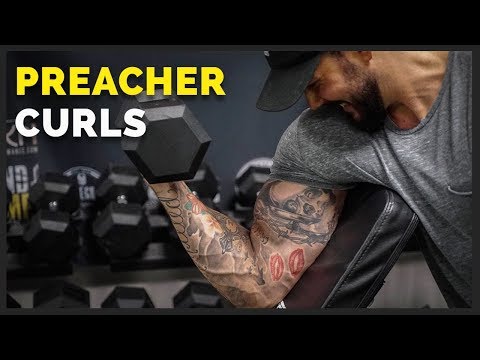
Dumbbell Preacher Curl Overview
The dumbbell preacher curl builds your biceps. Your biceps are the muscles on the front of your upper arm. Your forearms help too. You use one dumbbell and a preacher bench. The bench has an angled pad that props up your arm. You train one arm at a time. The dumbbell preacher curl is a great arm builder. The pad stops you from swinging. This forces your bicep to do all the work. It is good for lifters who want bigger, stronger arms. It also fixes a weak side. Use it on arm day or after your big pulling lifts.
What Is The Point of the Dumbbell Preacher Curl?
The dumbbell preacher curl isolates your biceps completely by stopping you from swinging or cheating. It builds serious arm size and strength.
How To Do The Dumbbell Preacher Curl
- Set the preacher bench so the top edge of the pad sits just under your armpit when you sit down. If the pad is too low, your shoulder rounds forward and the elbow loses support, so adjust the seat first.
- Sit with your chest against the pad and hold a single dumbbell in one hand with a palm-up grip. Working one arm at a time lets you brace the pad with your free hand and chase down a weaker side.
- Lay the back of your upper arm flat on the angled pad with the armpit right at the top edge. The pad should support the whole arm so the elbow cannot drift or lift.
- Start with the arm almost straight but keep a slight bend in the elbow, never a full dead-hang lockout. That soft bend protects the joint from the hard stretch the preacher angle creates.
- Take a breath, brace lightly, and curl the dumbbell up by contracting the bicep, keeping the wrist stacked and neutral. Drive the movement from the muscle, not by swinging the weight.
- Squeeze the bicep hard at the top for a full second, stopping just short of the point where the forearm goes vertical and tension drops off. That peak squeeze is the payoff of the preacher angle.
- Lower the dumbbell slowly over three seconds, feeling a deep stretch in the bicep as the arm nears straight. The preacher bench makes the bottom stretch its best and most vulnerable part, so control it.
- Stop just short of a full lockout at the bottom and go into the next rep. Finish all reps on one arm, then switch. Aim for 8 to 12 reps per arm for three to four sets.
Dumbbell Preacher Curl Form Tips
- Keep your whole upper arm flat on the pad.
- Keep your armpit pressed to the top of the pad.
- Never fully straighten your elbow at the bottom.
- Curl by squeezing your bicep, not by swinging.
- Squeeze hard at the top for a beat.
- Lower slow. Take about 2 to 3 seconds down.
- Keep your wrist straight and firm.
- Breathe out as you curl. Breathe in as you lower.
- Sit tall. Keep your chest against the pad.
Common Mistakes to Avoid for the Dumbbell Preacher Curl
- Fully straightening the arm at the bottom. Locking out hard at the bottom of a preacher curl puts a violent stretch on the bicep tendon at the exact angle where it is most exposed, which is a common way people strain or tear it. Always leave a slight bend and lower under control.
- Bouncing out of the bottom to start each rep. Using a rebound off the stretched position lets momentum launch the weight and yanks on the elbow tendon. Pause briefly at the bottom and curl with intent so the muscle does the lifting, not a bounce.
- Letting the armpit slide up off the pad. When the top edge of the pad slips below your armpit, the shoulder rounds forward and the elbow loses its shelf, turning strict curls into a shoulder swing. Sit so the pad sits snug under the armpit and keep it there.
- Rushing the lowering phase. Dropping the dumbbell fast throws away the eccentric, which is where the preacher curl shines for building the bicep, and it slams the elbow into that risky bottom stretch. Own a three second descent every rep.
- Cranking the wrist to help the curl. Bending the wrist back and rolling the dumbbell in shifts load to the forearm and drains the bicep. Keep the wrist stacked and neutral so the bicep stays the engine.
- Going too heavy and cutting the range. A weight you cannot control makes you stop halfway and rob the stretch, which is the whole reason to use a preacher bench. Drop the load and move through the full range from a slight bend to a hard squeeze.
- Lifting your chest off the pad to grind reps. Peeling off the pad recruits your back and shoulder to heave the weight and defeats the strict setup. Keep your chest planted so the arm works in isolation.
- Curling too far at the top until tension drops. Pulling the dumbbell past the point where your forearm goes vertical lets the bicep rest at the top. Stop just short so you keep constant tension on the muscle.
- Neglecting the weaker arm's honest reps. Training one arm at a time makes it tempting to short the weak side and pad the strong one. Let the weaker arm set the rep count and match it on the strong side.
- Holding your breath through heavy reps. Straining silently spikes your blood pressure and makes the last reps shaky. Exhale as you curl up and inhale as you lower to keep your brace and your head clear.
- Flaring the elbow out to the side on the pad. Letting the elbow drift outward changes the line of pull and stresses the joint. Keep the upper arm parallel and pinned so the force runs straight through the bicep.
Dumbbell Preacher Curl Workout Tips
- Respect the bottom stretch and never lock out hard. The preacher angle loads the bicep tendon most at the bottom. Keeping a slight bend protects the elbow while still training the muscle through a big range.
- Chase the peak contraction at the top. Squeezing the bicep hard for a second where the muscle is fully shortened builds a strong mind-muscle connection. Feeling the bicep work is one of the oldest reliable ways to grow it.
- Emphasize a slow three second eccentric. The preacher curl is one of the best moves for training the stretched position of the bicep. Lowering slowly under control is where much of the growth comes from.
- Work one arm at a time to fix imbalances. Single-arm curls expose a weaker side that a barbell would hide. Train the weak arm first and let it set the standard for the strong one.
- Keep the load moderate and the form strict. The bicep is a small muscle with a vulnerable tendon at this angle. Controlled reps beat ego weight every time on a preacher bench.
- Try a longer pause at the bottom on a few reps. Pausing in the stretched position kills the bounce and forces the bicep to work with no momentum. It is humbling and effective.
- Program preacher curls after your heavy back work. Your biceps get pre-fatigued from rows and pulldowns, so curls finish them off. Isolation moves fit best at the end of a pull day.
- Keep your wrist stacked and neutral throughout. A bent wrist leaks tension into the forearm and can strain the joint. A firm, straight wrist sends force straight into the bicep.
- Use 8 to 12 reps for size and slightly higher for the pump. The bicep responds well to moderate reps with good tension. Save very heavy low reps for compound pulls, not this.
- Do not let the dumbbell roll toward your fingers. Keep it seated in your palm so the working muscles stay loaded. Grip firmly without white-knuckling.
- Squeeze the free hand into the bench for stability. Bracing your other hand keeps your torso still and your chest planted. A stable base means cleaner isolation of the working arm.
- Add partial reps from the bottom when you hit failure. Short pulls out of the stretched range extend the set safely once full reps run out. It is a smart way to add intensity to a finishing move.
- Progress slowly with small dumbbell jumps. The bicep tendon does not love big leaps in load at this angle. Add weight in small steps as your control improves.
- Watch your elbow does not drift off the pad. If the arm creeps up the pad your range and safety both suffer. Reset your seat height so the pad supports the whole upper arm.
- Alternate preacher curls with incline curls for full development. Each angle hits the bicep in a different stretched or shortened position. Variety across the range builds a fuller muscle.
- Be patient with arm growth. Biceps are stubborn and grow slowly for most people. Consistent strict work over months is what finally moves the tape.








Questions & Comments
Be the first to ask a question about this exercise.