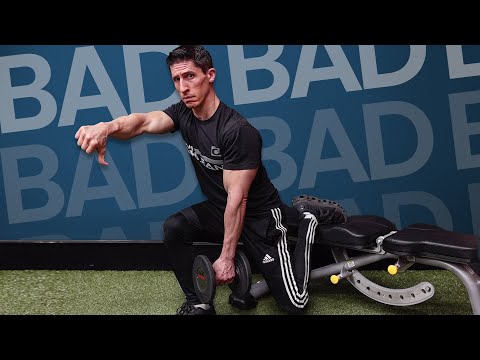
Bulgarian Split Squat Overview
The bulgarian split squat is a one-leg squat. Your back foot rests on a bench behind you. It builds your quads. Your quads are the big muscles on the front of your thighs. It also works your glutes, hamstrings, and calves. You only need your body and a bench. You can hold weights later to make it harder. This move builds strong, even legs. It fixes gaps between your left and right side. It also helps your balance. The bulgarian split squat is good for sports and daily life. It works well early in a leg workout. Start with just your body weight first.
What Is The Point of the Bulgarian Split Squat?
The Bulgarian split squat builds single-leg strength and fixes muscle imbalances. It targets your quads hard while improving balance and stability.
How To Do The Bulgarian Split Squat
- Stand about two to three feet in front of a bench or sturdy box, facing away from it. This distance controls your stance, and you will fine-tune it once your back foot is up.
- Reach one foot back and place the top of that foot, shoelaces down, on the bench behind you. This rear leg is there for balance and support, not for pushing, so keep most of your intent on the front leg.
- Hop your front foot forward or back until your front knee stays roughly over your ankle at the bottom of a rep. Too close and your knee shoots way past your toes, too far and you lose your quads, so find the middle ground.
- Stand tall with your chest up, your core braced, and your hips square to the front. Do not let your hips rotate open toward the back leg, because that twist leaks power and stresses your lower back.
- Take a breath, brace, and lower straight down by bending your front knee. Sink your back knee toward the floor rather than pitching your torso far forward, keeping the movement vertical and controlled.
- Descend for a two to three second count until your front thigh is roughly parallel to the floor, or as deep as your mobility allows cleanly. You should feel a strong stretch through the front-leg quad and glute.
- Pause for a beat at the bottom without resting your back knee on the ground. This kills any bounce and forces the front leg to own the load out of the hole.
- Drive up through the whole front foot, pushing the floor away, and exhale through the hardest part of the rep. Focus on your heel and mid-foot so the power comes from your quad and glute rather than the ball of your foot.
- Stop just short of locking the front knee to keep tension on the muscle, then start the next rep. Finish all your reps on one leg before switching, and aim for 8 to 12 reps per side for 3 to 4 sets.
Bulgarian Split Squat Form Tips
- Keep most of your weight on your front foot. The back foot only balances you.
- Keep your front knee over your ankle. Do not let it cave inward.
- Stand tall the whole time. Do not fold far forward.
- Keep your hips square to the front. Do not twist toward the back leg.
- Lower slowly. Take about 2 seconds down.
- Push through your whole front foot. Drive through the heel and mid-foot.
- Keep your belly tight. This holds your body steady.
- Breathe in on the way down. Breathe out as you push up.
- Keep your movement smooth. Do not bounce out of the bottom.
Common Mistakes to Avoid for the Bulgarian Split Squat
- Setting your front foot too close to the bench. A short stance jams your knee way out past your toes and dumps most of the load onto the joint. Step the front foot out until your shin can stay closer to vertical at the bottom, which shares the work between your quad and glute.
- Pushing off the back foot. Treating the rear leg as a second driver turns the lift into a shaky two-legged squat and steals the training effect from the front leg. Keep the back foot passive and light, using it only for balance while the front leg does the real work.
- Letting your hips rotate open. When your hips twist toward the back leg you lose square alignment, leak force, and put an uneven strain on your lower back. Keep both hip bones pointing straight ahead throughout the rep, as if headlights on your pelvis stay aimed at the wall.
- Pitching your torso too far forward. Folding over at the hips can shift the emphasis and, taken too far, rounds your back under load. Decide on your torso angle and keep it consistent, staying more upright if you want the quad to lead the movement.
- Rushing the descent. Dropping fast means you bounce out of the bottom and skip the eccentric, which is a big part of what builds the leg. Lower under control for two to three seconds so the muscle stays loaded the whole way down.
- Resting the back knee on the floor between reps. Tapping down and relaxing kills the tension and lets you cheat the hardest part of the rep. Stop just above the floor and reverse without a break so the front leg never gets a rest inside the set.
- Uneven work between legs. Most people have a stronger side that quietly takes over, and over months that builds a real imbalance. Always match reps and effort, and do your weaker leg first so it sets the rep count for the stronger one.
- Going too heavy too soon. Loading up before you own your balance turns the lift into a wobbly survival exercise with a broken bar path. Master the movement with bodyweight or light dumbbells first, then add small jumps as your stability improves.
- Letting the front knee cave inward. When the knee collapses toward the midline it tracks poorly and stresses the ligaments. Cue your knee to stay in line with your second toe and push it slightly out as you drive up.
- Bouncing at the bottom. Using a rebound to launch out of the hole hands the work to your tendons rather than your muscles. Control the bottom, pause briefly, and drive up with intent so the muscle does the lifting.
- Cutting the range of motion short. Stopping halfway down only trains a small slice of the movement and leaves size and strength on the table. Descend until your front thigh is about parallel, going as deep as you can while keeping your form honest.
- Staring at the floor and losing your posture. Dropping your head pulls your chest down and rounds your upper back over time. Fix your gaze on a point ahead of you to keep your spine long and your torso proud.
Bulgarian Split Squat Workout Tips
- Let your weaker leg set the standard. Do the weaker side first and match its rep count with the stronger side, since most people have an imbalance that quietly grows over months. Evening this out protects your knees and hips and makes both legs stronger in the long run.
- Adjust your torso angle to change the emphasis. Staying tall and upright pushes more work onto the quads, while a slight forward lean pulls in more glute and hamstring. Pick the version that matches your goal and keep it consistent across the set.
- Start with bodyweight to nail your balance. This lift punishes a wobbly setup, so grooving the pattern unloaded pays off before you touch dumbbells. Once you can descend and drive up smoothly, adding load feels natural.
- Hold dumbbells at your sides for easy loading. A dumbbell in each hand keeps the weight low and stable and does not fight your balance the way a barbell can. This is the simplest way to add progressive overload once bodyweight is easy.
- Try a front-racked or goblet load to stay upright. Holding a single dumbbell at your chest cues a taller torso and hammers the quad. It also lights up your core to keep you from tipping forward.
- Play with your stance width for comfort. A slightly wider or narrower gap between your feet can take pressure off a cranky knee or hip. Small tweaks in setup often solve pain that no amount of grinding will.
- Use a controlled eccentric for more growth. Lowering for two to three seconds keeps the muscle under tension longer than dropping fast. That slow negative is one of the most reliable ways to build the leg.
- Add a pause at the bottom to build strength out of the hole. A one second pause removes the bounce and forces the front leg to start the rep from a dead position. This carries over hugely to your squats and everyday strength.
- Program it after your main squat or as a standalone leg day staple. It works great as a second movement once your heavy bilateral work is done. The single-leg demand exposes and fixes weaknesses your two-legged lifts hide.
- Keep the rep range moderate for size. Most lifters build the most muscle here in the 8 to 12 rep range for 3 to 4 sets per leg. Going much heavier tends to wreck your balance before it challenges the muscle.
- Push through your whole front foot. Driving through the heel and mid-foot keeps the power in your quad and glute rather than the ball of your foot. This also keeps you more stable and stops you from tipping onto your toes.
- Brace your core like you mean it. A tight trunk keeps your hips square and your spine safe against the uneven single-leg load. Take a breath and brace before you descend on every rep.
- Elevate your front foot slightly for a deeper stretch. Standing your front foot on a small plate lets you sink lower and stretch the glute harder at the bottom. Only add this once you can control the standard depth cleanly.
- Film from the front and the side. The front view shows whether your knee is caving, and the side view shows your depth and torso angle. A quick video reveals more than how the set felt in the moment.
- Do not chase failure on a balance-heavy lift. Leaving a rep or two in the tank keeps your form clean and your knee tracking well. The last few grinding reps rarely build much and often just teach sloppy patterns.
- Be patient with the strength curve. Single-leg lifts feel humbling at first because balance and coordination lag behind raw strength. Stick with them for a few months and both your stability and your leg size will climb steadily.








Questions & Comments
Be the first to ask a question about this exercise.