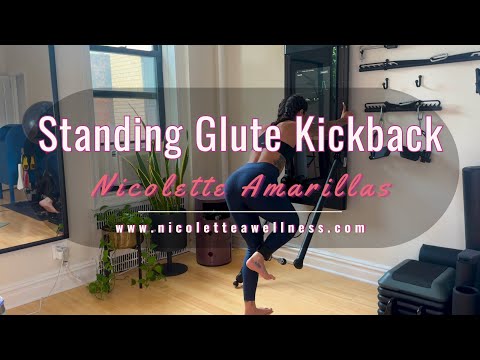
Standing Glute Kickback Overview
The standing glute kickback is a bodyweight move for your butt. It mostly works your glutes. Your glutes are the big muscles of your butt. It also works your hamstrings and your belly. Your hamstrings sit on the back of your thighs. You stand on one leg and lift the other leg straight back. You squeeze your glute at the top. The standing glute kickback is great for beginners. You need no gear, just a wall for balance. It builds strong, firm glutes and better hip control. Strong glutes help you walk, run, and lift with power. They also protect your lower back. This move fits well in a warm-up or a leg day. You can do it at home or at the gym.
What Is The Point of the Standing Glute Kickback?
The standing glute kickback exercise targets your glute muscles and helps build a stronger, firmer butt. It also works your core and improves hip stability.
How To Do The Standing Glute Kickback
- Stand tall with your feet about hip-width apart. Rest your hands on your hips or hold a wall, rail, or chair for balance and support.
- Shift your weight onto your left leg and put a soft bend in that knee. Brace your core and stand up straight so your torso does not tip forward much.
- Take a breath and lift your right leg straight back behind you, keeping the leg fairly straight or with a slight knee bend. Lead the movement with your heel.
- Focus on squeezing your right glute to drive the leg back, not on swinging it with momentum. The push should come from your butt, not your lower back.
- Raise the leg until you feel a strong contraction in your glute, usually when your thigh is a bit behind your body. Do not arch your lower back to go higher.
- Pause for a second at the top and squeeze the glute hard. This peak contraction is where the muscle does the most work.
- Lower your leg back down under control over 2 to 3 seconds. Resist the urge to let it drop and swing into the next rep.
- Keep your hips square and facing forward the whole time rather than opening them out to the side. Stay tall and braced between reps.
- Finish all your reps on the right leg, then switch to the left. Since this is a beginner glute move, aim for 12 to 20 controlled reps per side.
Standing Glute Kickback Form Tips
- Stand tall with your chest up.
- Keep your lifting leg fairly straight.
- Lift your leg back, not out to the side.
- Squeeze your glute hard at the top.
- Do not lean too far forward as you kick back.
- Keep your belly a little tight for balance.
- Move slowly both up and down.
- Breathe out as you lift. Breathe in as you lower.
- Hold a wall if you feel wobbly.
- Keep your standing knee slightly soft, not locked.
Common Mistakes to Avoid for the Standing Glute Kickback
- Arching the lower back to lift the leg higher. Once the glute reaches its limit, people crank the low back to raise the leg further, which stresses the spine. Keep your core braced and stop when the glute, not your back, is doing the lifting.
- Swinging the leg with momentum. Kicking the leg back fast uses a swing instead of the glute and gives the muscle almost no work. Slow the movement down and drive the leg back by squeezing the glute deliberately.
- Leaning the torso forward to counterbalance. Tipping way forward makes it easier to swing the leg but takes tension off the glute. Stay fairly upright and hold a stable, braced trunk.
- Not squeezing at the top. Blasting the leg back and immediately dropping skips the peak contraction where the glute works hardest. Pause and flex the glute for a second at the top of every rep.
- Rotating the hip open to the side. Turning the hip out lets other muscles help and shifts the leg out of a pure extension. Keep both hips square and facing forward so the glute does the work.
- Rushing through the reps. Fast, bouncy kickbacks rely on momentum and barely load the glute. Control both the lift and the lower so the muscle stays under tension.
- Dropping the leg on the way down. Letting the leg fall wastes the eccentric, which helps build and shape the muscle. Lower slowly over 2 to 3 seconds and keep the glute working.
- Losing your core brace. A loose trunk lets your back arch and your balance wobble. Tighten your abs and keep your torso stable so the movement stays clean.
- Bending the standing knee too much and squatting. If your support leg dips, the exercise turns into a mini-squat and loses focus on the glute. Keep just a soft bend in the standing leg and stay tall.
- Only using a tiny range of motion. Barely moving the leg back does not challenge the glute much. Extend the leg back far enough to reach a real contraction without arching your spine.
- Doing uneven reps between sides. Favoring your stronger side quietly builds a glute imbalance. Match reps and effort per leg and start with your weaker side to keep them even.
Standing Glute Kickback Workout Tips
- Drive the leg back by squeezing the glute, not swinging. Making the glute start and finish each rep is the whole point, and it turns a easy leg swing into real muscle work.
- Squeeze hard at the top and hold for a second. The peak contraction is where the glute works hardest, so pause and flex to get the most out of every rep.
- Keep your hips square and facing forward. Resisting the urge to rotate the hip open keeps the movement as pure hip extension and keeps the glute in charge.
- Stay tall and braced instead of leaning forward. An upright, stable torso keeps tension on the glute and protects your lower back from arching.
- Use a controlled 2 to 3 second lower on each rep. Owning the eccentric keeps the glute under tension and helps build and shape the muscle over time.
- Chase the mind-muscle connection. Really think about feeling the glute contract on each rep, since feeling the target muscle work is one of the most reliable ways to build it.
- Program kickbacks as a glute finisher or activation move. They are great before squats to wake up the glutes, or at the end of a leg day to burn them out.
- Aim for 12 to 20 reps per side for 3 to 4 sets. Higher reps with a strong squeeze suit this isolation move better than heavy low reps.
- Add a resistance band or ankle weight to progress. Once bodyweight feels easy, adding load is progressive overload and keeps the glutes challenged.
- Start each set with your weaker glute. Most people have a dominant side, so leading with the weak one and matching the strong side keeps you balanced.
- Keep the standing leg fairly straight with a soft knee. Locking in the support leg stops the move from turning into a squat and keeps the focus on the working glute.
- Try a pause at the top for a few sets. A longer hold in the contracted position removes momentum and forces the glute to work harder at its shortest, hardest point.
- Film a set from the side. Video shows whether you are arching your back or swinging, which is hard to feel while balancing.
- Use kickbacks to build the mind-muscle link for bigger lifts. Learning to feel and fire your glutes here carries over to stronger squats and hinges.
- Do not chase failure while learning the pattern. Leaving a rep in the tank keeps your form clean and your low back safe.
- Be consistent for glute shape. The glutes respond to steady, focused volume, so regular quality reps over months are what build them.








Questions & Comments
Be the first to ask a question about this exercise.