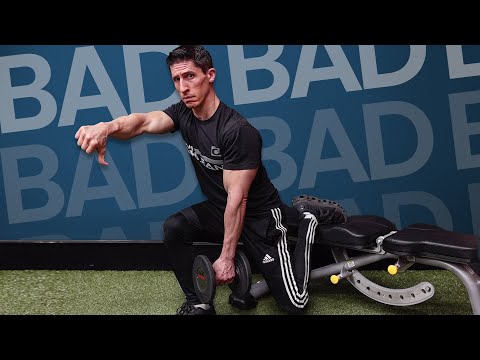
Split Squat with Banded Adduction Overview
The split squat with banded adduction builds your quads. The quads are the big muscles on the front of your thighs. You put a resistance band around both legs, just above your knees. You stand in a split stance with one foot forward. Your glutes, inner thighs, and hamstrings help too. The inner thighs are your adductors. The band adds work for your inner thighs and hips. You must fight the band the whole time. That builds strong, steady legs. The split stance also trains one leg more than the other. This fixes weak spots. It fits well on a leg day. It is best for lifters with some practice.
What Is The Point of the Split Squat with Banded Adduction?
The split squat with banded adduction builds single-leg strength while targeting your inner thighs. It improves balance and hits multiple muscle groups at once.
How To Do The Split Squat with Banded Adduction
- Loop a resistance band around both legs just above your knees so it pulls your knees gently inward. Step into a split stance with one foot forward and the other back, roughly two of your foot-lengths apart, up on the ball of the rear foot.
- Stand tall with your torso upright and your weight mostly on your front leg. Brace your core lightly and set your front foot flat so you can push through the whole thing.
- Feel the band trying to pull your front knee inward. Your job is to press that knee out against the band so it tracks in line with your toes, which fires up the glutes and outer hip while you squat.
- Lower straight down by bending both knees, sinking until your rear knee drops toward the floor and your front thigh is about parallel. Keep most of your weight on the front heel and mid-foot the whole way down.
- Control the descent over about two to three seconds and keep fighting the band so your front knee never caves in. You should feel your front quad and glute loading up along with the outer hip.
- Drive up through your front heel to return to the start, pushing the floor away and keeping your torso tall. Do not let the band snatch your knee inward as you rise, keep pressing it out.
- Keep your front knee tracking over your toes on every rep and your core braced so your torso does not fold forward. The band adds a constant reason to stay honest with your knee position.
- Finish all your reps on one leg before switching your stance to work the other side. Because this is a single leg movement with a stability demand, work in the 8 to 12 rep range per leg for 3 to 4 sets, and match the count on both legs.
Split Squat with Banded Adduction Form Tips
- Keep your torso upright. Do not lean too far forward.
- Put most of your weight on your front leg.
- Push the band out with your knees. Do not let them cave in.
- Push through your front heel to stand. Feel your quad work.
- Lower with control. Do not drop fast.
- Keep your core tight the whole set.
- Keep your front knee in line with your foot.
- Breathe in as you lower. Breathe out as you rise.
- Keep the band tight from start to finish.
Common Mistakes to Avoid for the Split Squat with Banded Adduction
- Letting the band pull your front knee inward. The whole point of the band is to make you resist that inward collapse, so caving in defeats the exercise and stresses the knee. Actively press your knee out in line with your toes on every rep.
- Putting too much weight on the back leg. Leaning back onto the rear foot turns this into a shared lift and takes the load off the front quad and glute. Keep the majority of your weight on the front heel and mid-foot.
- Taking too short a stance. A stance that is too narrow forces your front knee way out over your toes and can bother the joint. Step out far enough that both knees can bend to about 90 degrees at the bottom.
- Folding your torso forward. Letting your chest drop toward your thigh shifts the load off the quad and stresses your lower back. Stay tall and proud through the chest with a braced core the whole rep.
- Cutting the depth short. Doing shallow half reps skips the range where the quad and glute do the most work. Sink until your front thigh is about parallel and your rear knee nears the floor.
- Rushing the descent. Dropping fast wastes the eccentric and makes it harder to control your knee against the band. Lower over two to three seconds so the muscles stay loaded and your knee tracks true.
- Bouncing off the bottom. Using a bounce to spring back up throws away tension and can jar the knee. Reach a controlled bottom and drive up smoothly through the front heel.
- Losing your balance and rushing to reset. Wobbling and stutter-stepping breaks tension and makes the set sloppy. Fix your eyes on a spot ahead, brace your core, and move at a steady pace to stay stable.
- Not matching reps between legs. Most people have a stronger side that quietly does more, and over months that builds a real imbalance you can see. Do your weaker leg first and let it set the rep count for the stronger side.
- Letting the band slip out of position. A band that rolls up or down your thigh changes the pull and can snap loose. Set it just above the knees where it can do its job and check it between sets.
- Pushing off the back toe to cheat. Driving hard off the rear foot turns the split squat into more of a lunge and unloads the front leg. Treat the back leg as a kickstand for balance, not a second engine.
Split Squat with Banded Adduction Workout Tips
- Treat the band as a coach for your knee. Its constant inward pull teaches you to press your knee out and track it over your toes, a habit that protects the joint in every squat and lunge you do.
- Keep the load on your front leg. Think about pushing the floor away with your front heel, which keeps the quad and glute doing the work rather than the back leg.
- Press your knee out hard against the band the whole rep. Fighting that pull fires up the glute medius and outer hip, which builds the stability that keeps knees healthy.
- Use a controlled two to three second descent. Owning the lowering phase keeps the quad and glute under tension and makes it easier to control your knee against the band.
- Live in the 8 to 12 rep range per leg for 3 to 4 sets. That range builds the quad and glute while still letting you focus on clean knee tracking.
- Train your weaker leg first and match the stronger side to it. Letting the weak leg set the rep count slowly evens out the imbalance most people carry.
- Stay tall through your torso with a braced core. An upright trunk keeps the load on the legs and protects your lower back throughout the movement.
- Fix your eyes on a spot ahead for balance. A steady gaze quiets the wobble so you can focus on the muscles instead of fighting to stay upright.
- Add difficulty by holding dumbbells once bodyweight is easy. Loading up progresses the exercise while the band keeps your knee honest under the heavier weight.
- Program this as an accessory on leg day. It pairs well after your main squat, adding single leg strength and hip stability when your big lifts are done.
- Set the band just above your knees and check it each set. Keeping it in the right spot ensures a steady inward pull and stops it from rolling loose.
- Film a set from the front now and then. A quick phone video shows whether your knee is caving or tracking well far better than how it feels.
- Slow down and add a pause at the bottom for more challenge. A brief pause kills momentum and forces your legs to start each rep from a dead stop.
- Keep your rear foot as a light kickstand. Using it only for balance, not power, ensures the front leg gets the full workload it is meant to.
- Progress by adding reps or a small pause before adding weight. Patient overload with clean knee tracking builds strength without ever letting the joint drift into a bad position.
- Be consistent and honest with both sides. Single leg work exposes weak links, so steady practice on both legs is what builds balanced, resilient hips over time.








Questions & Comments
Be the first to ask a question about this exercise.