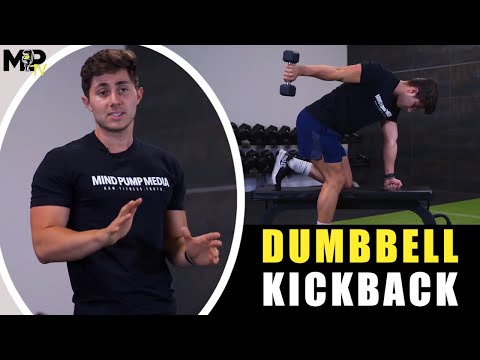
Dumbbell Tricep Kickback Overview
The dumbbell tricep kickback works the back of your arm. That muscle is your tricep. It is the big muscle on the back of your upper arm. You need one dumbbell and a flat bench. You put one knee and one hand on the bench. Then you press one dumbbell straight back. The dumbbell tricep kickback is a great beginner move. It shapes and firms the back of your arm. It teaches you to feel your tricep work. You can do it near the end of an arm day. Use a light weight and go slow. This move rewards control, not heavy loads.
What Is The Point of the Dumbbell Tricep Kickback?
The dumbbell tricep kickback exercise targets the back of your arms to build stronger, more defined triceps. It's perfect for shaping your arms and adding real strength.
How To Do The Dumbbell Tricep Kickback
- Pick a light to moderate dumbbell to start. The kickback is a small movement with a long lever, so it feels heavier than it looks and ego loading here ruins the whole point.
- Place your left knee and left hand on a flat bench and hold the dumbbell in your right hand. Set your back flat and roughly parallel to the floor, chest proud, and brace your core so your spine does not sag or round.
- Pull your right shoulder blade down and back to pin the upper arm in place. Raise that upper arm until it is parallel to the floor and tucked close to your ribs. This is the fixed pivot for the entire set.
- Let your forearm hang straight down so your elbow sits at about 90 degrees. Take a breath and brace before the first rep.
- Extend your elbow and drive the dumbbell back until your arm is fully straight and in line with your torso. The only joint that moves is the elbow, so keep that upper arm glued in place.
- Squeeze the triceps hard at the top and hold for a beat. This peak contraction is where the muscle actually gets loaded, so do not rush past it.
- Lower under control on a two to three second count until your forearm is vertical again. Resist the weight on the way down instead of letting it drop.
- Keep your wrist neutral and avoid swinging your shoulder to help. Finish all your reps on the right, then switch your stance and repeat with the left arm.
- Aim for 10 to 15 reps per arm for 3 sets, since this lift responds better to controlled volume than heavy weight.
Dumbbell Tricep Kickback Form Tips
- Keep your back flat like a table. Do not let it round or sag.
- Pin your elbow to your side. It should not drift or swing.
- Move only your forearm. Your upper arm stays still and level.
- Straighten your arm fully at the top. This is where the tricep works most.
- Squeeze for one second at the top. Then lower with control.
- Keep your wrist straight and firm. Do not let it bend back.
- Breathe out as you press back. Breathe in as you lower.
- Keep your neck long and easy. Look at the floor a bit ahead.
- Use a light dumbbell. Good form matters more than heavy weight.
Common Mistakes to Avoid for the Dumbbell Tricep Kickback
- Dropping the upper arm as you tire. The moment your elbow sinks below parallel, the movement turns into a partial row and the triceps stop doing the work. Lock that upper arm against your side and keep it parallel to the floor for every single rep.
- Swinging the dumbbell with momentum. If you heave the weight back with your shoulder and torso, you are moving load with English, not muscle. Slow down, drop the weight a notch, and make the triceps extend the elbow on their own.
- Going too heavy. Because the arm is a long lever out behind you, a kickback punishes overloading more than most exercises, and heavy weight forces you to cheat. Pick a weight you can straighten fully and squeeze at the top for all your reps.
- Cutting the extension short. Stopping before your arm is fully straight skips the peak contraction, which is exactly where the triceps are loaded hardest. Straighten the elbow completely and hold that lockout for a beat before lowering.
- Rounding your back over the bench. A sagging or hunched spine means you have lost your brace and are putting stress on your lower back. Set a flat, neutral back roughly parallel to the floor and keep your core tight the whole set.
- Rushing the lowering phase. Letting the forearm swing back down fast throws away the eccentric, which builds real muscle. Control a two to three second descent so the triceps stay under tension both ways.
- Bending the wrist as you press back. A cocked wrist leaks force and can strain the joint under repeated reps. Keep the wrist neutral and firm so the line of force runs straight through your forearm.
- Flaring the elbow away from your body. When the elbow drifts out wide, the shoulder starts sharing the load and your position gets unstable. Keep the upper arm pinned tight to your ribs so the triceps stay isolated.
- Twisting your torso to finish reps. Rotating your trunk to fling the weight up is a sign the load is too heavy and takes tension off the target. Stay square to the bench and let the elbow do the job.
- Racing through the reps. Blasting through the set with no control means little time under tension for a muscle that already gets small loads here. Slow every rep down and feel the triceps work through the full range.
- Neglecting the peak squeeze. Treating the top as a turnaround point instead of a contraction wastes the best part of the exercise. Pause and consciously flex the triceps at full extension on each rep.
Dumbbell Tricep Kickback Workout Tips
- Treat the kickback as a finisher, not a mass builder. It shines at the end of an arm or push day once heavier pressing has already fatigued the triceps and you want to chase a hard peak contraction.
- Chase the mind-muscle connection here more than the weight on the dumbbell. Because the load is light, feeling the triceps squeeze at lockout matters far more than the number, so slow down and actually feel it work.
- Keep the upper arm slightly above parallel if your shoulder allows. Angling the elbow a touch higher increases the stretch and lengthens the range the triceps have to control.
- Pause for a full second at the top of every rep. That brief hold kills momentum and forces the long and lateral heads of the triceps to hold tension with no help from swing.
- Use a controlled eccentric of two to three seconds. Owning the lowering phase keeps the muscle loaded on the way back and adds real growth stimulus to an otherwise easy movement.
- Program it for higher reps, usually 10 to 15 per arm for 3 sets. This lift rewards volume and a good pump rather than grinding heavy singles.
- Try a cable or band version for constant tension. A cable set low keeps resistance on the triceps even at lockout, where a dumbbell offers almost none because gravity pulls straight down.
- Film yourself from the side once in a while. A quick video instantly shows whether your upper arm is drifting down, which is nearly impossible to feel in the moment.
- Keep the working shoulder blade set down and back. A stable scapula gives the upper arm a firm anchor so the elbow can extend cleanly against a fixed base.
- Match reps and effort on both arms. Your dominant side will try to take over across a workout, and over months that quietly builds an arm imbalance you can see, so let the weaker arm set the pace.
- Squeeze the dumbbell handle firmly throughout. A tight grip creates irradiation up the arm that helps stabilize the elbow and lets you contract the triceps harder.
- Superset it with a curl for an efficient arm finisher. Pairing kickbacks with a biceps move keeps blood in the arm and saves time at the end of a session.
- Progress with reps before weight. Add a rep or two per arm each week and only bump the dumbbell once you can hit the top of your range with clean form.
- Do the weaker arm first. Starting with your less capable side sets an honest rep target that your stronger arm then matches, which keeps both arms developing evenly.
- Avoid resting the dumbbell on your leg between reps. Keeping the forearm hanging maintains tension and stops you from stealing a break that shortens time under tension.
- Be patient with triceps development. The kickback is a detail move that polishes the horseshoe shape over time rather than adding slabs of size overnight, so keep it consistent.








Questions & Comments
Be the first to ask a question about this exercise.