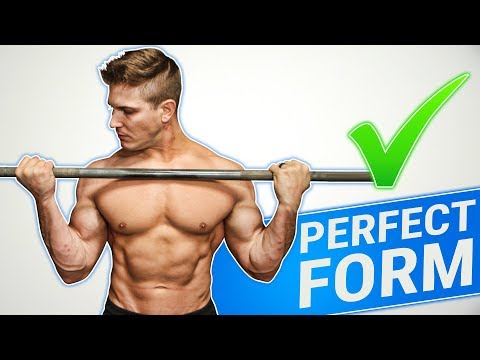
Barbell Curl Overview
The barbell curl is a classic arm move. It works your biceps, the muscles on the front of your arms. It also works your forearms. You need one barbell. You hold it with your palms up and curl it to your chest. The barbell curl builds bigger, stronger biceps. It lets you move more weight than dumbbells. This helps your arms grow. It suits beginners well. Put it on arm or pull days. Keep your elbows still and do not swing. Feel your biceps work on every single rep.
What Is The Point of the Barbell Curl?
The barbell curl exercise builds bigger, stronger biceps through focused arm flexion. It's the classic move for building impressive arm size and strength.
How To Do The Barbell Curl
- Stand with your feet about hip-width apart and hold a barbell with an underhand grip about shoulder-width. Let the bar hang at arm's length against your thighs.
- Set your shoulders back and down and brace your core. Keep your elbows tucked close to your sides, since they should stay pinned there for the whole set.
- Take a breath and curl the barbell up toward your chest by bending at the elbows. Squeeze your biceps to move the weight and keep your upper arms still.
- Keep your elbows glued to your sides as you curl. Only your forearms should move, so avoid swinging your elbows forward to help.
- Curl until the bar reaches the top and your biceps are fully contracted. Do not let your body rock back or your elbows drift, since that steals tension from the biceps.
- Squeeze your biceps hard at the top for a beat. Feel the contraction rather than just touching the bar to your chest.
- Lower the barbell slowly and under control back to the bottom, aiming for a 2 to 3 second descent. Let your biceps stretch fully at the bottom without letting the bar swing.
- Keep your torso still and avoid using momentum for every rep. Most people build well in the 8 to 12 rep range for 3 to 4 sets.
Barbell Curl Form Tips
- Keep your elbows close to your sides. Do not let them drift.
- Keep your upper arms still. Move only your forearms.
- Curl the bar with your palms facing up.
- Squeeze your biceps hard at the top.
- Lower slowly. Control the weight down.
- Keep your wrists straight and firm.
- Stand tall. Do not lean back to lift.
- Keep your core tight to stay steady.
- Breathe out as you curl. Breathe in as you lower.
Common Mistakes to Avoid for the Barbell Curl
- Swinging the weight with your body. Rocking your torso back to heave the bar up uses momentum and takes the work off your biceps. Stand tall, brace your core, and let only your forearms move.
- Letting your elbows drift forward. When your elbows swing up and forward, the front delts take over and the biceps lose tension. Pin your elbows to your sides and keep them there the whole set.
- Using too much weight. Overloading the bar forces you to cheat with your back and cut your range. Pick a load you can curl strictly, then add small jumps over time as progressive overload.
- Cutting the range short at the bottom. Never fully straightening your arms skips the stretch and builds strength in only part of the range. Lower the bar all the way down between reps.
- Rushing the lowering phase. Dropping the bar fast wastes the eccentric, which is one of the best parts for building the biceps. Control a slow 2 to 3 second descent every rep.
- Only curling halfway up. Short reps that never reach a full squeeze leave gains on the table. Curl all the way up and squeeze your biceps hard at the top.
- Letting the wrists bend back. A cocked-back wrist leaks force and can strain the joint. Keep your wrists firm and neutral so the load runs into the biceps.
- Shrugging the shoulders up. Letting your shoulders ride toward your ears pulls the traps and delts into the lift. Keep your shoulders packed down so the biceps stay in charge.
- Bouncing the bar off your thighs. Using a bounce at the bottom to start the next rep is just momentum. Pause briefly and curl up with control.
- Overarching your lower back to help. Leaning back to swing the bar up strains your spine and cheats the biceps. Keep your core braced and your torso upright.
- Speeding through the reps. Moving fast means the biceps never really work under tension. Slow down and focus on feeling the squeeze and stretch.
Barbell Curl Workout Tips
- The barbell curl is the classic biceps builder because it lets you load both arms heavily at once. Keep it strict and it will do more for your arms than any fancy variation.
- Keep your elbows pinned to your sides. Letting only your forearms move is what keeps the tension on the biceps and off the front delts.
- Use a slow eccentric of 2 to 3 seconds. Lowering under control builds the biceps more than letting the bar drop.
- Squeeze your biceps hard at the top of every rep. A firm contraction builds the mind-muscle connection and makes the reps count.
- Stand tall and brace your core to kill the swing. A stable torso forces your biceps to do the work honestly.
- Lower the bar all the way to a full stretch each rep. Training the full range hits more of the muscle than short partial curls.
- Program curls after your back work or on an arm day. Your biceps are already warm from pulling, so they fit naturally there.
- For size, work in the 8 to 12 rep range for 3 to 4 sets. Higher reps with strict form build the biceps well.
- Add weight in small, steady jumps you can control. Progressive overload with clean form beats piling on plates and swinging.
- Try an EZ bar if the straight bar bothers your wrists. The angled grip lets your wrists sit in a more natural position, which is easier on the joints while still loading the biceps hard.
- Use a slight cheat only at the very end of a hard set. A controlled cheat rep can extend a set, but do not build the whole set on momentum.
- Chase the feel, not just the number on the bar. Feeling your biceps work is what actually grows the arm.
- Film a set from the side. Video shows whether your elbows drift or your body swings, which is hard to feel.
- Do not train to failure on every set. Leaving a rep in the tank keeps your form clean and your elbows healthy.
- Vary your grip width now and then. A slightly narrower or wider grip shifts the emphasis across the biceps and forearms.
- Keep your wrists firm and neutral. A stable wrist sends the load straight into the biceps.
- Be patient. Bigger arms come from months of consistent, strict curling, not one heavy session.








Questions & Comments
Be the first to ask a question about this exercise.