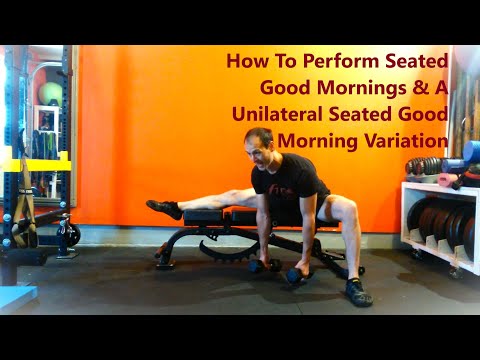
Seated Good Mornings Overview
The seated good mornings move makes the back of your body strong. It works your hamstrings, the muscles on the back of your thighs. It also works your glutes and your lower back. Your glutes are your butt muscles. You sit on a bench and bend forward at your hips. You need no weight at all. The seated good mornings move is great for beginners. It teaches you how to hinge at your hips. This is a key skill for lifting safe. It also helps your posture and a healthy back. You can do it at home on any sturdy bench. Use it in a warm-up or on leg day.
What Is The Point of the Seated Good Mornings?
Seated good mornings strengthen your hamstrings and glutes while being easier on your lower back than the standing version. Perfect for building posterior chain strength.
How To Do The Seated Good Mornings
- Sit on the end of a sturdy bench with your feet flat on the floor about shoulder width apart. Sitting removes the balance demand of a standing good morning and lets you focus purely on the hip hinge.
- Place your hands behind your head or crossed over your chest. Behind the head keeps your torso long, while crossed arms are a bit easier if your shoulders are tight.
- Sit tall with your chest up and pull your shoulder blades back. Set a long, neutral spine from your hips all the way to the top of your head before you move.
- Take a big breath into your belly and brace your core hard. This bracing turns your torso into one solid unit and protects your lower back through the whole hinge.
- Hinge forward at the hips by pushing your chest toward your thighs. The movement comes from the hips folding, not from your spine rounding, so keep that back flat.
- Lower until you feel a strong stretch through your hamstrings and your torso is well forward, or until your back is about to round. That stretch is your true bottom, so do not force past it.
- Drive your hips back under you and squeeze your glutes to bring your torso upright again. Push the movement from the back of your legs and your seat, not your lower back.
- Return to a tall seated position and reset your breath if needed. Keep the spine long the entire time and aim for 10 to 15 controlled reps to learn the hinge and load the hamstrings.
Seated Good Mornings Form Tips
- Bend at your hips, not your waist. Push your hips back as you lean.
- Keep your back flat like a board. Do not let it round.
- Keep your core tight the whole time. This guards your lower back.
- Move slowly and with control. No fast drops.
- Feel the stretch in your hamstrings at the bottom.
- Squeeze your glutes hard as you sit back up.
- Keep your neck in line with your back. Do not crane it.
- Breathe in as you lower. Breathe out as you rise.
- Only go as far as your flat back allows. Stop before it rounds.
Common Mistakes to Avoid for the Seated Good Mornings
- Rounding the back instead of hinging at the hips. If your spine curls forward, the movement stops being a hip hinge and starts loading your lower back discs directly. Keep a long, flat spine and fold from the hips, treating your torso as one rigid piece.
- Losing your core brace mid-rep. When you let air out and go soft through the middle, your spine has nothing supporting it as you lean forward. Take a big breath, brace hard before you hinge, and hold that tension until you are upright again.
- Going too far down before you can control it. Chasing depth past your flexibility forces the lower back to round to keep going. Stop at the point of a strong hamstring stretch with a flat back, and only build range as your mobility improves.
- Turning it into a spinal crunch. Some people fold at the mid back rather than the hips, which trains nothing useful and stresses the spine. Feel the crease happen at your hip joints and keep your ribcage locked to your pelvis.
- Rushing the reps. Bouncing quickly in and out of the bottom removes control and puts your back in a bad spot at the worst moment. Lower slowly, feel the hamstrings load, and rise with intent.
- Not feeling the hamstrings at all. If you only feel your lower back working, your hinge is off and the target muscle is being skipped. Push your chest forward while keeping the spine long so the stretch lands in the back of your legs.
- Letting the chest cave and shoulders round. A collapsed chest pulls your upper back into flexion and cascades down the spine. Keep your chest proud and shoulder blades set to hold a strong, tall posture through the hinge.
- Craning the neck up or tucking the chin hard. Looking straight up strains the neck, while tucking the chin fully rounds the top of the spine. Keep your head in line with your torso and let your eyes travel down naturally.
- Using the arms to yank yourself up. Pulling on your head with your hands or throwing your arms adds no useful load and can strain the neck. Keep the hands light behind your head and drive up from the hips and glutes.
- Placing the feet too close together. A narrow base makes it harder to hinge cleanly and can feel unstable. Set your feet about shoulder width and flat so you have a solid platform to fold over.
- Forgetting to squeeze the glutes at the top. Coming up without finishing the hip extension leaves the movement incomplete and shortchanges your glutes. Drive your hips forward and squeeze at the top of every rep.
Seated Good Mornings Workout Tips
- Use the seated good morning to teach the hip hinge safely. Sitting removes the balance challenge, so you can focus entirely on folding at the hips while keeping a flat back.
- Treat this as a movement primer as well as a hamstring exercise. It is a superb warm up before deadlifts or standing good mornings because it grooves the exact hinge pattern you will need.
- Keep the reps higher, around 10 to 15, especially while you are learning. Lighter, controlled volume builds the pattern and stretches the hamstrings without overloading your spine.
- Chase the stretch, not the depth. The goal is a strong pull through the hamstrings with a flat back, so stop where your flexibility runs out rather than forcing your torso lower.
- Brace your core like you are about to be poked in the stomach. That tension protects the lower back and is a habit worth building on every hinge you ever do.
- Move slowly and own the eccentric. Lowering under control loads the hamstrings through their stretch and keeps your spine safe at the deepest, most demanding point.
- Progress the arm position as you get stronger. Crossing the arms is easiest, hands behind the head is harder, and reaching the arms overhead adds even more challenge to your torso.
- Add this as an accessory on leg or posterior chain days. It complements curls and deadlifts by hammering the hamstrings in their lengthened, hinged position.
- Film yourself from the side to check your spine. It is hard to feel a small round in your back, but a quick video makes any loss of the flat position obvious.
- Once bodyweight feels easy, hold a light plate to your chest. This is a natural way to add progressive overload without jumping straight to a loaded barbell.
- Keep your feet flat and rooted the whole time. Pressing your heels down gives you a stable base and helps you drive the hips back on the way up.
- Exhale as you rise and squeeze your glutes at the top. Finishing each rep with full hip extension trains the glutes and reinforces a strong lockout.
- Do not train this to grinding failure. A hinge under fatigue is where form breaks down, so leave a couple of clean reps in the tank and stop while your back is still tight.
- Pair it with hamstring curls for full development. Good mornings load the stretch and the hip, while curls hit the knee bending action, and together they build well rounded hamstrings.
- Keep your neck neutral by looking at a spot on the floor ahead of you. A long spine from tailbone to skull spreads the load and protects the neck.
- Be consistent and patient. Hinging well is a skill, and a few weeks of clean seated good mornings will pay off in every deadlift and squat you do afterward.








Questions & Comments
Be the first to ask a question about this exercise.