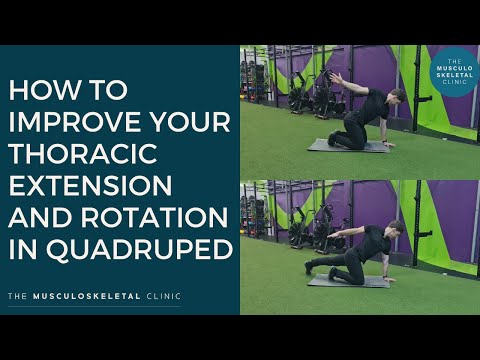
Quadruped Extension Rotation Overview
The quadruped extension rotation is a floor move for your glutes. The glutes are your butt muscles. It also works your lower back and hamstrings. The hamstrings are the muscles on the back of your thighs. You start on your hands and knees. You need no equipment at all. You just use your own body weight. This move is great for beginners. It wakes up your glutes and hips. Strong glutes help you walk, run, and squat better. It also builds better hip control. You can do the quadruped extension rotation at home on a mat. It fits well in a warm-up or a glute workout.
What Is The Point of the Quadruped Extension Rotation?
The quadruped extension rotation exercise builds glute strength while improving hip mobility and core stability. It helps fix muscle imbalances and strengthens your backside.
How To Do The Quadruped Extension Rotation
- Start on all fours with your wrists stacked directly under your shoulders and your knees under your hips. Spread your fingers and press the floor away so your upper back stays broad and you are not sinking into your shoulders.
- Set your core before you move. Take a breath into your belly, gently draw your ribs down toward your hips, and imagine balancing a glass of water on your lower back so your spine stays flat and level.
- Bend your right knee to 90 degrees so your shin points at the ceiling and your foot is flat to the sky. This bent-knee shape is what keeps the work in the glute instead of letting the hamstring take over.
- Lift that bent leg straight back and up until your thigh is roughly in line with your torso. Squeeze the glute to drive the motion and keep your hips square to the floor rather than letting them tip open.
- From the top, rotate the lifted leg out to the side like a gate swinging on a hinge at your hip. Go only as far as you can while your pelvis stays level and facing down.
- Feel the outer glute and the deep hip muscles working as you rotate. This external rotation is the whole point of the drill, so move slowly and stay in control the entire way.
- Rotate the leg smoothly back to center under control, keeping the knee bent and the thigh lifted. Do not let it flop back or lose the height you built.
- Lower the knee back down to the start position with control, then reset your brace before the next rep. Move at a steady pace, around 2 seconds per phase, and avoid rushing.
- Finish all your reps on one side before switching to the other leg. Most people do well with 10 to 15 controlled reps per side for 2 to 3 sets.
Quadruped Extension Rotation Form Tips
- Keep your wrists right under your shoulders. This protects your arms.
- Keep your back flat like a table. Do not let it sag or round.
- Keep your knee bent at 90 degrees the whole time.
- Move slowly and with control. Fast, jerky reps miss the glute.
- Rotate from your hip, not your lower back. Keep your hips level.
- Squeeze your glute as you open your leg out.
- Look down at the floor. This keeps your neck in line.
- Keep your belly tight to hold your body steady.
- Breathe out as you rotate out. Breathe in as you come back.
Common Mistakes to Avoid for the Quadruped Extension Rotation
- Letting your lower back sag and your belly drop toward the floor. When the core switches off, your lumbar spine arches to lift the leg and the glute barely fires. Brace your abs and keep a flat, level back so the hip does the work instead of your spine.
- Rotating your hips open as the leg lifts and turns. It feels like you get more range, but you are just twisting your pelvis rather than moving the leg at the hip. Keep both hip bones pointing at the floor and only move as far as you can hold that square position.
- Straightening the knee during the rotation. A straight leg shifts the tension onto the hamstring and lower back and takes it off the glute you are trying to target. Keep that knee locked at a firm 90 degrees the whole time.
- Swinging the leg with momentum instead of muscle. Throwing the leg up and around makes the drill look bigger but robs the glute of tension and stresses the joint at the end range. Move slowly and make the muscle earn every inch.
- Sinking into your shoulders and collapsing your upper back. If you hang on your shoulder joints, your whole setup goes soft and unstable. Push the floor away and keep your chest broad so you have a solid base to work from.
- Cranking your neck up to look forward. Lifting the head jams the base of your neck and pulls your spine out of its neutral line. Keep your gaze down at the floor so your head follows your spine.
- Chasing range you cannot control. Forcing the leg wider than your hip can handle just twists the pelvis and irritates the joint. Own a smaller, clean arc and let your range grow as your control improves.
- Holding your breath through the reps. A locked breath usually means your brace is passive and your midsection is not truly supporting you. Breathe steadily and keep gentle tension in your abs from start to finish.
- Rushing to pile on reps instead of feeling the glute. Speed trains momentum, not the muscle, and this is a low-load drill where control is everything. Slow down and actually feel the outer hip working each rep.
- Uneven work between sides. Most people have a stronger, more coordinated hip and let it dominate, which quietly deepens an imbalance over time. Do your weaker side first and match its rep count on the stronger one.
- Bearing down hard on the wrists with locked elbows. Dumping all your weight into stiff, straight arms strains the wrists. Keep a micro-bend in the elbows and grip the floor with your fingers to spread the load.
Quadruped Extension Rotation Workout Tips
- Think of your torso as a rigid table and only the hip as the moving joint. That mental picture keeps your spine quiet and forces the glute to do the lifting and turning.
- Squeeze the glute deliberately at the top of every rep. Chasing that mind-muscle connection turns a vague leg lift into real, targeted work for the muscle you actually want to train.
- Move slowly, around 2 seconds to lift, rotate, and return. Time under tension is what makes a bodyweight drill like this effective, since there is no external load to challenge you.
- Keep both hip bones pointed at the floor as your anti-cheat cue. If you feel one hip rise, you have lost the position and the glute has handed the job to your lower back.
- Place a hand or a light object on your lower back for a few reps. If it wobbles or slides, you know your core has gone soft and your spine is moving.
- Use this as a warm-up or activation drill before squats, hinges, or running. Waking up the glutes first helps them fire in your bigger lifts instead of staying lazy.
- Do your weaker hip first and let it set the standard. Matching the stronger side to the weaker one is one of the simplest ways to even out a nagging imbalance over months.
- Try a one-second pause at the fully rotated position. Pausing kills momentum and forces the deep hip rotators to hold tension where they are usually weakest.
- Keep your neck long and your gaze down toward your hands. A neutral head keeps the whole spine aligned and takes strain off your neck.
- Progress by adding reps, slowing the tempo, or adding a light ankle band before anything else. Better control and cleaner range beat piling on speed every time.
- Breathe out gently as you lift and rotate the leg. Exhaling helps you keep your ribs down and your core braced through the hardest part of the rep.
- If you feel this in your lower back rather than your glute, shrink your range and re-check your brace. That ache almost always means your pelvis is twisting or your spine is arching.
- Pair it with clamshells and glute bridges for a well-rounded hip routine. Training the glutes through lifting, bridging, and rotating covers all the jobs the muscle does.
- Keep your supporting knee and shin planted and stable. A quiet base leg lets you focus all your attention on the working hip instead of fighting for balance.
- Film yourself from the side or behind now and then. A quick phone video shows hip twist and back sag far more clearly than how the movement feels in the moment.
- Be patient and consistent with it. Deep hip control builds slowly, but strong, well-coordinated glutes protect your knees and lower back and power almost everything athletic you do.








Questions & Comments
Be the first to ask a question about this exercise.