Leg Curl Overview
The leg curl works your hamstrings. Your hamstrings are the muscles on the back of your thighs. You lie face down and curl your heels to your butt. The machine gives smooth, steady resistance. It also works your glutes a little. You need a lying leg curl machine. The leg curl is great for beginners. It builds strong, full hamstrings. Strong hamstrings help you run and jump. They also protect your knees. This move balances all your quad work. Use it on leg day. Put it after your big lifts as a finisher.
What Is The Point of the Leg Curl?
The leg curl exercise builds stronger hamstrings and better knee stability. It helps balance your quad strength and prevents injury during running and jumping.
How To Do The Leg Curl
- Set the machine so the ankle pad sits just above your heels when you lie face down. Adjust the pad and any hip support so you are locked in comfortably.
- Lie face down with your legs straight and your ankles hooked under the padded lever. Grip the handles to anchor your upper body.
- Press your hips down into the bench and brace your core. Keeping your hips down stops you from arching your lower back to cheat the weight up.
- Take a breath and curl your heels toward your glutes by bending your knees. Lead with the hamstrings rather than jerking the weight.
- Curl until your hamstrings are fully contracted, bringing your heels as close to your glutes as the machine allows. Squeeze hard at the top for a beat.
- Feel the hamstrings work through the whole curl. Do not let your hips pop up off the bench as you approach the top.
- Lower the weight slowly under control, taking 2 to 3 seconds. Resist the lever the whole way down and never let it slam, because the eccentric is where much of the hamstring growth happens.
- Stop just short of a fully locked, resting position so tension stays on the hamstrings, then start the next rep. Keep your upper body relaxed and let the hamstrings do all the work. The leg curl builds the hamstrings well in the 10 to 15 rep range for 3 to 4 sets.
Leg Curl Form Tips
- Press your hips down into the bench the whole time.
- Keep your upper body still. Only your knees bend.
- Curl your heels toward your glutes.
- Squeeze your hamstrings hard at the top.
- Lower the weight slowly. Do not let it slam.
- Line up your knees with the machine hinge.
- Keep your feet and ankles relaxed, not pointed hard.
- Breathe out as you curl. Breathe in as you lower.
- Move slowly and smoothly. No jerking the lever.
Common Mistakes to Avoid for the Leg Curl
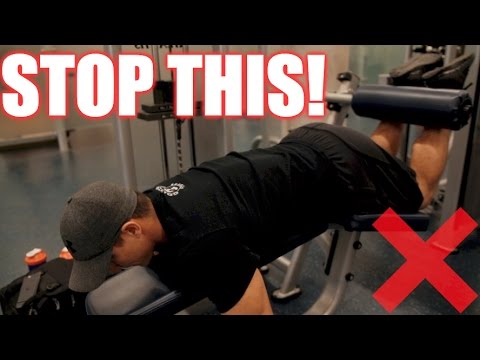
- Lifting your hips off the bench. When you arch your lower back and pop your hips up to fling the weight, you cheat the hamstrings and strain your spine. Press your hips down into the pad and keep them there the whole set.
- Using momentum to swing the weight up. Jerking the lever with a fast, bouncy motion takes the work off the hamstrings. Curl smoothly and let the muscle move the load.
- Going too heavy. Ego weight forces you to arch, swing, and cut the range short. Pick a load you can curl fully and lower slowly with your hips pinned down.
- Letting the weight slam down. Dropping the lever fast wastes the eccentric, one of the best growth phases for the hamstrings. Control the lowering over 2 to 3 seconds every rep.
- Not curling all the way up. Stopping short of a full contraction leaves the peak squeeze unused. Bring your heels as close to your glutes as the machine allows and squeeze.
- Setting the ankle pad wrong. If the pad sits too high on your calf or too low on your foot, the leverage is off and your ankles take strain. Position it just above your heels for a clean curl.
- Curling with pointed toes only out of habit. Foot position can subtly shift the emphasis, and locking into one extreme can cramp your calves. Keep a natural, relaxed foot position unless you are experimenting on purpose.
- Rushing through the reps. Fast, half-range curls barely work the hamstrings. Slow down, feel the muscle, and control both directions.
- Holding your breath the whole set. Locking your air spikes blood pressure and reduces control. Exhale as you curl and breathe steadily between reps.
- Not squeezing at the top. Blowing past the fully curled position misses the strongest hamstring contraction. Pause and clench the hamstrings at the top of each rep.
- Neglecting the hamstrings elsewhere and relying only on this. The leg curl trains knee flexion but not the hip-hinge role of the hamstrings. Pair it with hinges and deadlifts for complete hamstring development.
Leg Curl Workout Tips
- Press your hips into the bench the whole set. Keeping the hips down stops you cheating and keeps the tension squarely on the hamstrings.
- Squeeze hard at the top of each curl. A firm peak contraction is where the hamstrings do their best work and it builds the muscle fully.
- Control the lowering for 2 to 3 seconds. A slow eccentric is a powerful hamstring builder, so never let the weight slam down.
- Curl through a full range. Bringing your heels close to your glutes and letting the legs straighten out works the muscle from every angle.
- Chase the mind-muscle connection. Thinking about the hamstrings pulling your heels in makes even a machine move far more effective.
- Use higher reps than for a big lift. The hamstrings respond well to 10 to 15 controlled reps for 3 to 4 sets.
- Program it alongside hip hinges. The leg curl trains knee flexion while deadlifts and Romanian deadlifts train the hip side, and together they build complete hamstrings.
- Add weight in small steps over time. Progressive overload grows the hamstrings, but only if your hips stay pinned as you add load.
- Try single-leg curls to fix imbalances. Working one leg at a time keeps a stronger side from carrying a weaker one.
- Do not slam the weight or bounce reps. Controlled reps protect your knees and keep the hamstrings under real tension.
- Great for balancing quad-dominant training. Strong hamstrings protect your knees and even out the front-to-back development of your legs.
- Squeeze the handles to stay anchored. A firm grip keeps your upper body stable so your hamstrings can work freely.
- Try a slow eccentric emphasis on some sets. Lowering over 4 seconds cranks up the growth stimulus without needing more weight.
- Warm up your knees and hamstrings first. A light set primes the muscles and joints before your working weight.
- Do not let a strong side take over on both-leg curls. If one leg dominates, add single-leg work to even things out over time.
- Finish leg day with a couple of higher-rep sets. As a burnout, the leg curl floods the hamstrings and leaves them thoroughly worked.








Questions & Comments
Be the first to ask a question about this exercise.